


Emeric J Charles, Christie C Sze, Benjamin L Oakes, Sarah K Denny, Jason D Fernandes
Sep 2026
Highlights
Enabling ultra-long gene silencing without changing DNA: ELXR epigenetic silencers use DNA methylation to enable persistent treatment while keeping DNA sequence unchanged.
“Two-factor authentication” for gene silencing: A novel approach, termed “Sequential Proofreading”, requires a silencer to find the correct DNA address, then establish and read the required chromatin state before methylating DNA.
More than 10-fold greater specificity: Sequential proofreading maintained durable silencing while substantially reducing unintended effects in human cells and mice.
No toxicity observed in stress tests: The CasX-based sequential-proofreading ELXR architecture completely rescued growth defects observed with Cas9-based silencers during prolonged, high-level exposure.
More than 4-fold greater activity: Instead of trading activity for specificity, sequential proofreading increased silencing at every target tested.
Mechanism mirrors natural regulation: Mutational studies confirm that sequential proofreading works by leveraging the cell’s natural system for sensing chromatin state and controlling DNA methylation.
Epigenetic silencing: Durable repression without changing DNA sequence
CRISPR-based genome editing changes DNA permanently. That permanence can support lifelong benefit, but it can also make unintended changes difficult to undo. Epigenetic silencing offers another path. Unlike genome editing or base editing, it leaves the original DNA sequence intact and unlike RNAi, its effects can persist without continued treatment. Instead epigenetic silencing sits in a Goldilocks zone between these approaches and uses the natural chemical marks that cells rely on to control gene activity. These types of marks, for example, allow cells in the eye and heart to carry the exact same DNA sequence yet perform entirely different functions.
Because epigenetic silencing works through the cell’s own regulatory machinery, it also benefits from several natural layers of control that make durable unintended changes less likely. For instance, around 80 percent of the DNA sites that can be methylated are already marked, meaning that there are very few sites left for unintended methylation to occur. Additionally, lasting silencing requires multiple signals (e.g. histone marks, methylation spread) to all converge within the right regulatory region. If those conditions are not met, the cell can reverse the change.
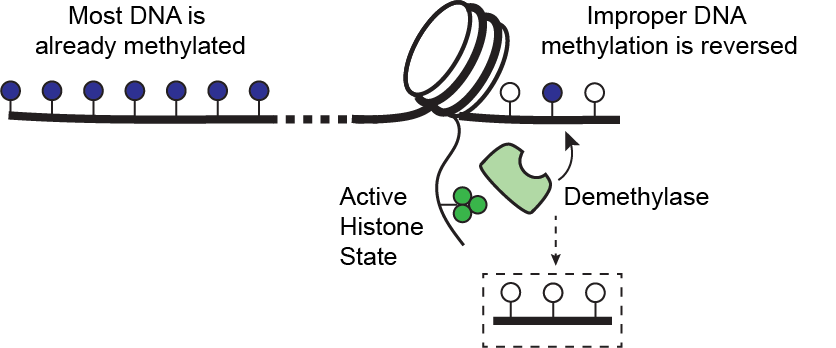
Figure 1: Natural safeguards limit unintended epigenetic silencing. Most sites in the genome are already methylated, while marks placed in the wrong context can be removed by the cell.
These natural safeguards reduce the chance that unintended methylation will have a lasting effect, but they do not control the methyltransferase activity itself, creating an opportunity to engineer another layer of specificity control. To find its target, every CRISPR-Cas system must scan the genome and briefly sample many other DNA sequences. If the methyltransferase remains active along the way, these passing encounters can lead to unintended methylation.
Sequential proofreading addresses this gap by keeping the methyltransferase locked until the silencer has established and verified the conditions required to act.
Building two-factor authentication into gene silencing
To treat diseases affecting millions of people, an epigenetic silencer must do more than find the right gene. It must also know when it is ready to act. That led us to ask: What if gene silencing required the molecular equivalent of two-factor authentication?
The first check confirms the DNA address. The second confirms the surrounding chromatin state. Importantly, the silencer does not simply find a site that is already prepared for methylation. It establishes the required chromatin state and then verifies that state before proceeding, creating a deliberate set of gated proofreading events that must occur in sequence.
We engineered this logic into Epigenetic Long-term X-Repressors, or ELXRs, built on Scribe’s highly specific CRISPR-CasX platform. At the heart of the system is an allosteric regulatory domain called the ADD, which acts as both a lock and a sensor. It keeps the DNA methyltransferase inactive until it recognizes the correct chromatin state. Rather than acting immediately after reaching a target, an ELXR must complete four dependent steps:
Search and bind: CRISPR-CasX finds the intended DNA sequence and positions the ELXR at its target.
Establish: A repressor reshapes the surrounding chromatin, creating the histone state required for durable silencing.
Sense and unlock: The ELXR recognizes the state it has established and unlocks its methyltransferase.
Write: The activated methyltransferase modifies DNA and then recruits the cell’s own machinery to extend the signal across the target region.
We call this process sequential proofreading. Unlike conventional epigenetic approaches in which histone state and DNA methylation are established simultaneously and independently, to our knowledge ELXRs are the only epigenetic silencing technologies engineered to complete each step before moving to the next --establishing substantially greater fidelity and persistence.
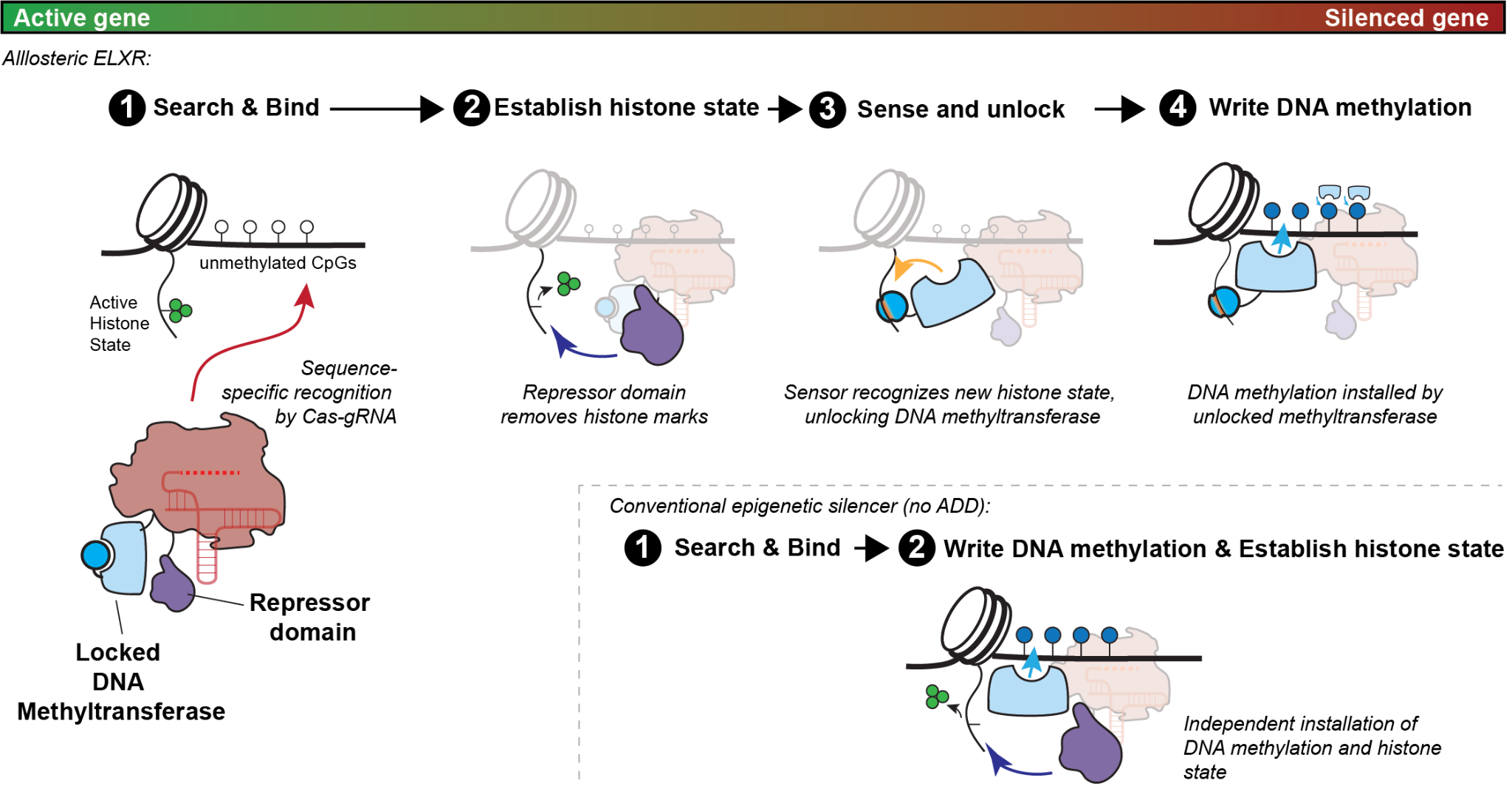
Figure 2: Sequential proofreading in epigenetic silencers. An ELXR targets DNA, establishes the correct histone state, then senses and unlocks its DNA methyltransferase domain. Only then does the methyltransferase domain activate and write DNA methylation which spreads across the locus.
Result 1: More than 10x improvement in specificity from sequential proofreading
Implementing sequential proofreading led to a dramatic increase in specificity. In liver-derived cell lines, the original silencer altered the expression of more than 150 genes. Sequential proofreading reduced those changes to only the intended gene.
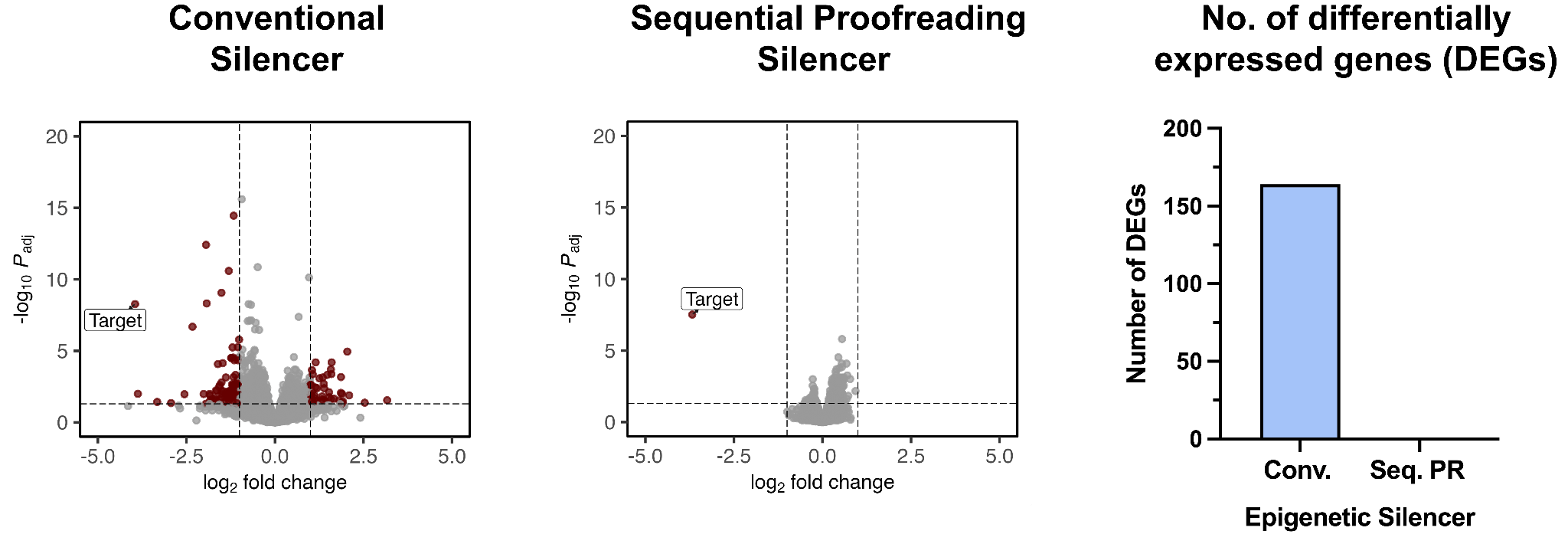
Figure 3: Sequential proofreading reduced the number of differentially expressed genes in a human liver cell line.
The same pattern held in primary human liver cells, where the sequential proofreader affected only the targeted gene. We also measured DNA methylation across the genome at single-site resolution in these cells. In cells from two independent donors, sequential proofreading reduced unintended methylation by more than 10-fold.
Result 2: No observed toxicity at high doses compared to previous Cas9-based epigenetic systems
We also found that adding the sensor-and-lock regulatory switch was not enough to enable sequential proofreading on any DNA binding domain. When we attempted to introduce the same allosteric control into Cas9-based silencers, we did not see any specificity improvements. Under high-expression conditions, the Cas9-based fusions failed to prevent growth defects even when we fused the regulatory switch to the methyltransferase. The benefit therefore came from the complete architecture: a highly engineered and specific CRISPR-CasX targeting system working together with the repressor, methyltransferase, and regulatory switch.
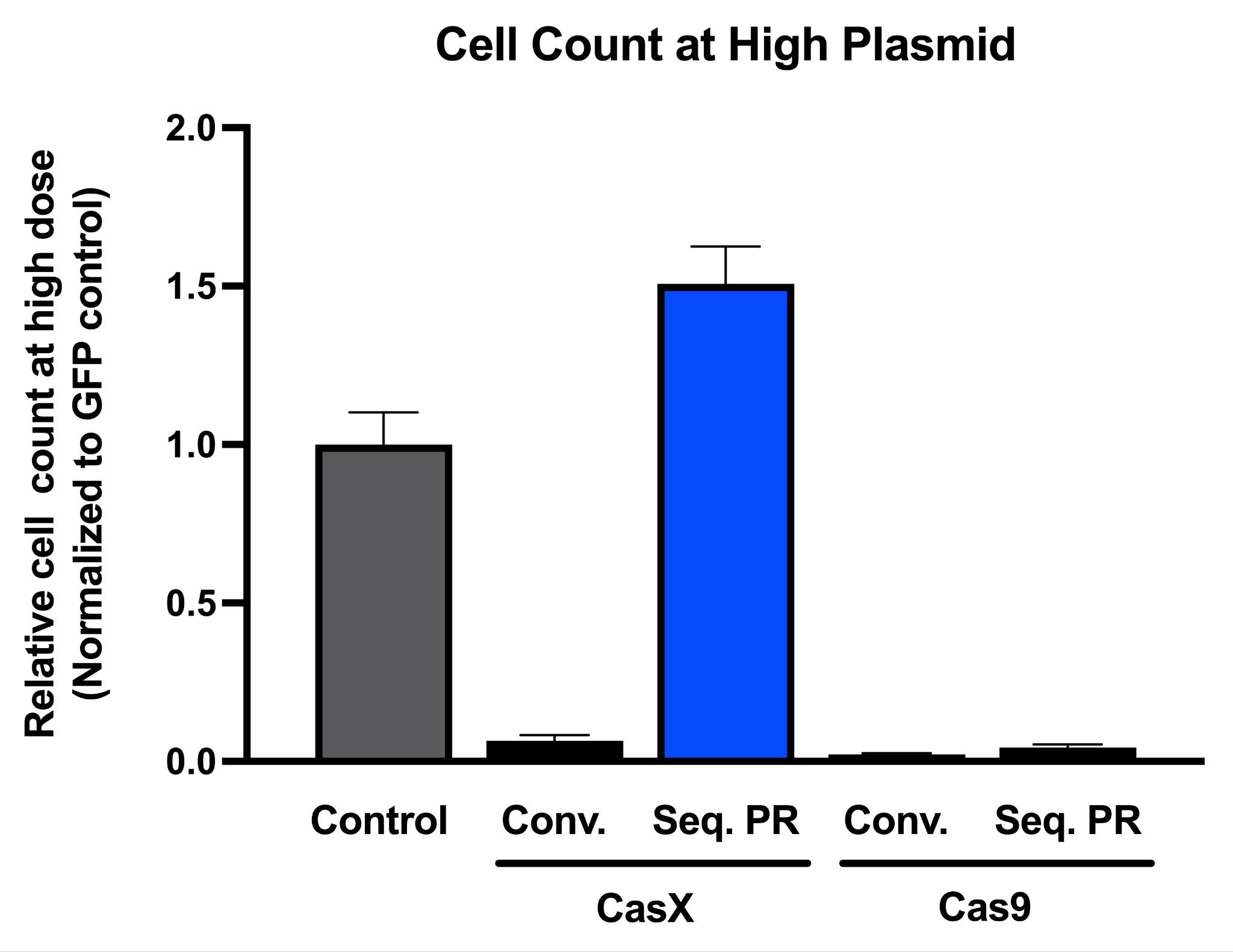
Figure 4: Sequential proofreading prevented growth defects caused by high levels of the CasX-based silencer, but not the Cas9-based silencers tested.
Result 3: Potency improves 4-fold greater across all targets
Unexpectedly, sequential proofreading increased the activity of our ELXR molecules across multiple target genes. Additional specificity checkpoints are often assumed to impose a tradeoff, with performance exchanged for greater specificity. But ELXRs with sequential proofreading actually did the opposite. Rather than trading activity for specificity, they improved both, increasing activity by an average of fourfold across all targets tested.
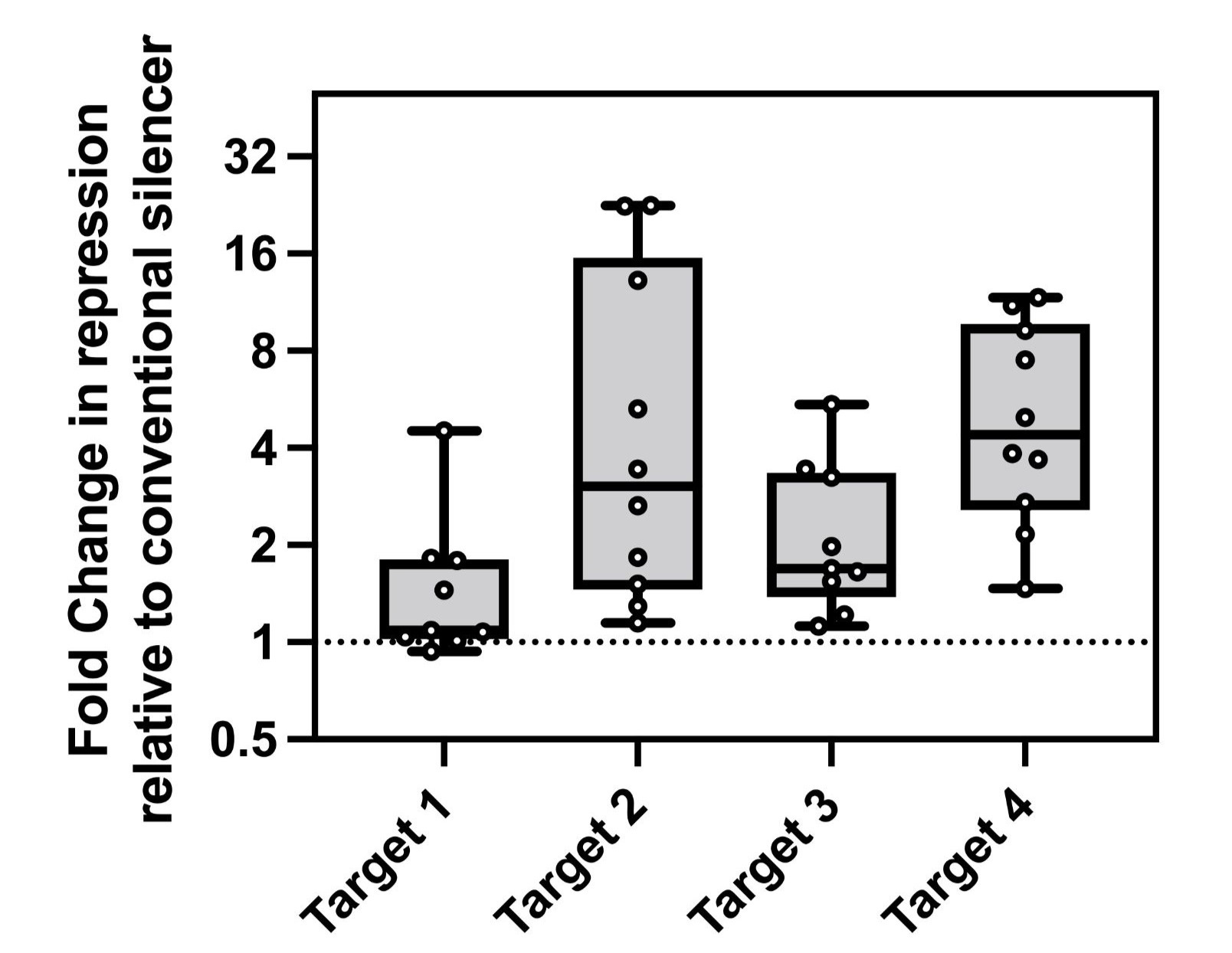
Figure 5: Sequential proofreading increased activity across every intended target tested. Each point represents activity of a single gRNA’s activity fold increase when tested with a sequential proofreader compared to a conventional silencer. Each target was tested with multiple, different gRNAs.
Result 4: Mechanistic studies demonstrate sequential proofreading leverages natural control pathways
To confirm that sequential proofreading works through the proposed mechanism, we tested constructs that disrupted either the establishment or sensing of the required histone state. When we mutated the histone sensor/lock domain so that it could no longer recognize the correct state, durable silencing was lost. Removing the repressor domain also led to a loss of activity as the correct histone state was never established. Together, these experiments confirmed that sequential proofreading depends on two linked steps: first establishing the correct histone state, then recognizing it before DNA methylation begins.
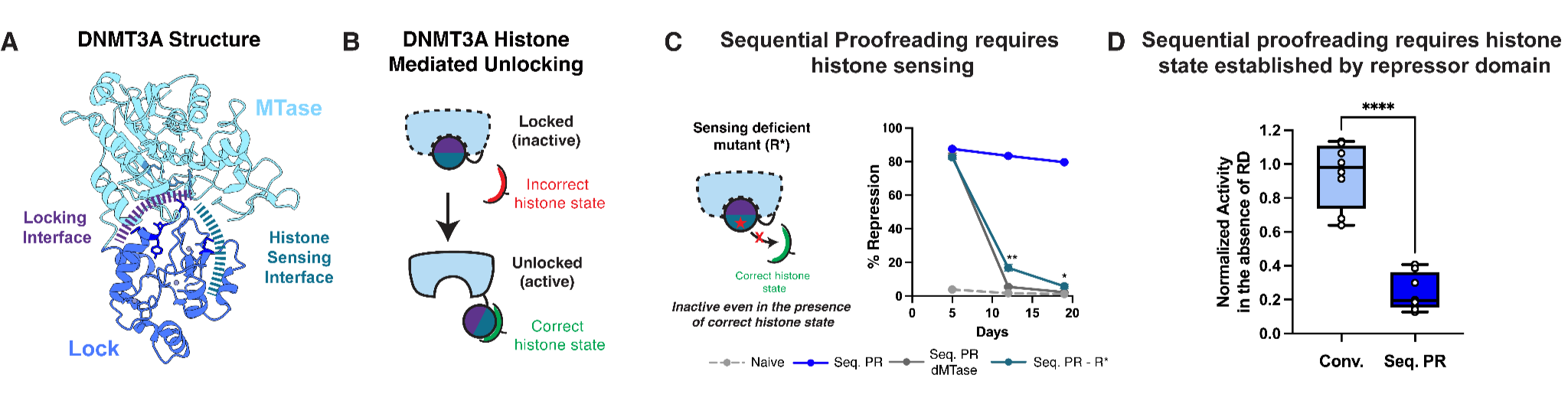
Figure 6: A–B) The DNA methyltransferase contains a catalytic domain (light blue) and a histone-sensing regulatory domain (dark blue) that acts as a lock. Recognition of the correct histone state releases the lock and activates DNA methylation. C) A sensing-deficient mutant cannot release the lock, preventing durable silencing. D) Removing the repressor domain also reduces sequential-proofreading activity because the silencer can no longer establish the histone state it needs to sense. Conventional silencers remain active because they lack this dependency.
Why this matters
This points to a broader lesson in molecular engineering. Biological regulation is not always a constraint to engineer away. In the right architecture, the same checkpoints that control where a system acts can also make it work better. From a therapeutic viewpoint, this creates practical flexibility that expands the applications of epigenetic editing: improving options for dosing and relaxing the considerations for gRNA selection. ELXR is a result of these lessons; it does not merely find the right target. It establishes the right conditions, verifies them, and only then acts.
The next step? Getting these allosteric epigenetic editors to the patients who need them.
Read more in our preprint describing this work.
Really clear write-up, and the fact that you published the negative result alongside the wins is what makes it convincing.
The Cas9 comparison in Result 2 is the part doing the most work for me. Showing that the same ADD lock bolted onto a Cas9 backbone gave no specificity gain is what turns sequential proofreading from a domain story into an architecture story, and most write-ups would have quietly left that panel out.
What I keep coming back to is whether that result and the fourfold activity gain are the same observation. If the methyltransferase stays locked through the sampling phase, none of the effector pool is spent on transient encounters, so more of it is still catalytically available once the histone state is established at the intended site. Specificity and potency would then not be two separate wins but one consequence of gating the write step behind the search. Curious whether the on-target kinetics you saw fit that reading.